The Lookalikes: Life-o-phobia
Get off on the Grid with the Lookalikes!
by Mike Rechner
This article appeared in the March 1998 Antimatters. It was one in a series of trippy, almost songlike analytical album essays that Prewar Yardsale's Mike Rechner wrote for the 'zine around that time, which also included "The Narrative of Lenny Molotov", "Contradiction for the Campfire: Lach's Antihoot" and "Transfer from Albany -Rob Scane's Nowheresville". I'm a big fan of Mike's songs and Prewar Yardsale. Enjoy!--se.
 The
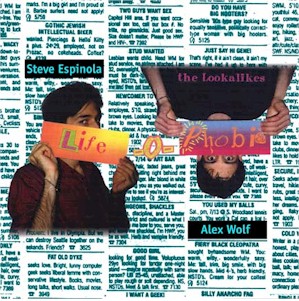
Lookalikes understand structure. They fabricate it, melt it, carry it
on their shoulder or let it drop. Their cassette Life-o-phobia
constructs and projects the Seattle personal advertisements as vehicles
for their insights on human condition. The Lookalikes use the grid structure
of personal ad layout as a method of organization. Personal advertisements
appear in almost every newspaper and some magazines, and are conceived
as a way for like-minded people to meet. People compose their own advertisements
by describing what kind of person they are and what type of person they
want to meet. The ad is then placed (usually for a fee) in a publication
from which the composer expects the best response. The effectiveness of
these advertisements is debatable, however their entrenchment and usage
are not.
The
Lookalikes understand structure. They fabricate it, melt it, carry it
on their shoulder or let it drop. Their cassette Life-o-phobia
constructs and projects the Seattle personal advertisements as vehicles
for their insights on human condition. The Lookalikes use the grid structure
of personal ad layout as a method of organization. Personal advertisements
appear in almost every newspaper and some magazines, and are conceived
as a way for like-minded people to meet. People compose their own advertisements
by describing what kind of person they are and what type of person they
want to meet. The ad is then placed (usually for a fee) in a publication
from which the composer expects the best response. The effectiveness of
these advertisements is debatable, however their entrenchment and usage
are not.
The personal advertisements are laid out on whole as a rigid repetitive grid structure. When one looks closer and examines the content of each boxed ad, very distinct information becomes available. The new information introduces personal characteristics about the person who composed the ad. These personal characteristics infuse a human element into the regimented static presentation. The grid drops away as content emerges as the new source of structure. The new structure, regimented now by space limitations and compositional bluntness, re-grids itself into a newer non-linear (yet just as static) presentation.
When interest in the contents wanes, structure shifts back again to standard grid form. Words are arranged on a page systematically, like so much typewritten graph paper.
How to break this stasis of static structure!? Respond to an ad, which would bring static information off the page into dialogue! Total disregard for this method of communication, foraging out dialogues without the precursor of the personals but with every intention to connect!
Life-o-phobia, the cassette written, performed and produced by the Lookalikes (Steve Espinola and Alex Wolf) is structured first on content. With an emphasis on songs as wide-ranging in style as Bossa-Nova, Waltz and straightforward Rock and Roll, Espinola and Wolf never impose the limitations one might if composing a personal ad. Instead, the duo do their best to embrace outside the brackets of such narrow confines. Songs like "Gravy Blubber Spam," "Fool in Love," Arthur Murray's Dance Nightmare," "Let's Go to the Dance" and "You Whip Me" careen about with a joyous absurdity, ready to jump off the actual tape at any second and definitely not submitting to the confinement and restrictions of the personals. However, however great the euphoria is for these two writers, the downside is not far behind. Songs like "Old Man," "Wind and Water," and "You've Lost Everything" definitely put the depression back into Manic/Depression. They are almost as absurd in their all-out emotional collapse as the earlier mentioned songs are in the euphoric release. When faced with the actual personals themselves, as in "From a Stranger #1, #2, #3", Espinola and Wolf become more like presenters or handlers, coddling the disconcerting content of actual advertisements and advice columns amidst swaths of layered percussion and abstract nests of awkwardly tuned homemade instruments. By incorporating the actual absurd (the personals) and displaying a wide range of emotions themselves, Espinola and Wolf are able to sidestep the nihilism associated with the absurd and offer it a multi-dynamic aspect. In this aspect, possibility may be fruitless, but also endless and soothing, as when the Lookalikes together sweetly croon the closing song "Gentle Ballad of Love."
How do Espinola and Wolf navigate their way through the tangled web of
their own personal lives and the lives of hundreds of non-sleepers in
Seattle? In the song "Gravy Blubber Spam," Espinola introduces
the idea of gestalt as a method of semiotic guidance through which people
are able to make innate decisions via some sort of undisclosed specific
drive. Espinola counters the action of another's aggressive behavior by
throwing "salt at your gestalt" accompanied with the outburst
of resignation, "You're pushing me the wrong way down a one-way escalator,
long ago I should have said later sweet potato, you step on my nose, you
step on my toes but my love for you just grows and grows." Clearly
the songwriter is unclear as to the relationship to the protagonist in
the song. The nature of that relationship and the rest of the ideas presented
throughout the cassette continually shift emphasis and focus as the ideas
overlap and recontextualize each other in endless combinations. The cassette
format can also act as a grid. The combination, implosion and explosion
of lyrics and song structure act as content. Grid and content switch places
a lot on this cassette, the structure is the content 'til the content
is the structure etc. However the Lookalikes' main structure is content.
The content arranged to mediate the possibility of the music extending
from the structure and content of the cassette to content structure of
something actual. Like a cassette, a song, personal ad, a city a content
or a structure. The Lookalikes understand structure.
***** ***** *****
[Back
to the Merchandise Page]